


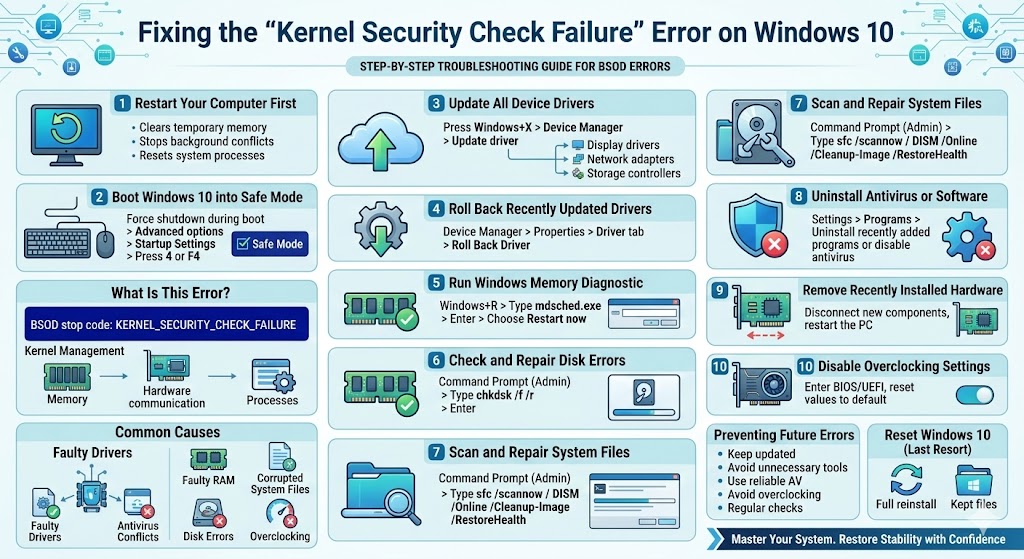
Fixing the “Kernel Security Check Failure” Error on Windows 10
The Kernel Security Check Failure error is a common Blue Screen of Death (BSOD) problem in Windows 10. When it appears, your computer suddenly crashes, shows a blue screen with a stop code, and then restarts. This can happen while gaming, during startup, when waking from sleep, or even during normal everyday use.
Although the name sounds serious, this error is usually caused by software or driver issues rather than permanent hardware damage. In many cases, it can be fixed with careful troubleshooting and system maintenance.
This complete guide explains what the Kernel Security Check Failure error means, why it happens, and how to fix it step by step.
What Is the Kernel Security Check Failure Error?
The Windows kernel is the core component of the operating system. It manages memory, hardware communication, and system-level processes. A Kernel Security Check Failure occurs when Windows detects data corruption or inconsistencies that could compromise system stability or security.
When Windows detects this problem, it stops the system immediately to prevent further damage, resulting in a BSOD.
You may see messages such as:
-
KERNEL_SECURITY_CHECK_FAILURE
-
Stop code: KERNEL_SECURITY_CHECK_FAILURE
Sometimes, the error appears repeatedly, making the system difficult to use.
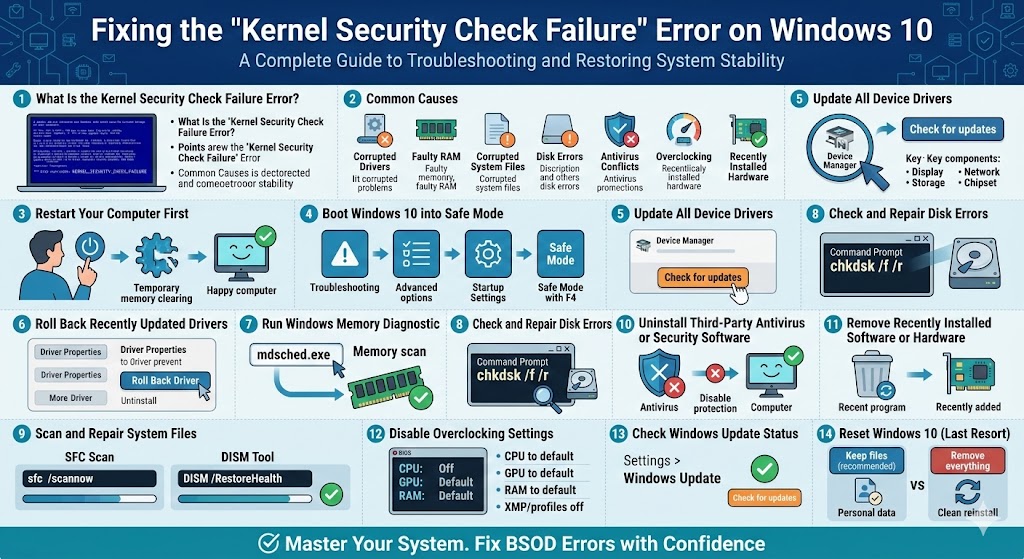
Common Causes of Kernel Security Check Failure
Understanding the cause helps you choose the right solution. The most common causes include:
-
Corrupted or outdated device drivers
-
Incompatible drivers after Windows updates
-
Faulty or mismatched RAM
-
Corrupted system files
-
Third-party antivirus or security software conflicts
-
Disk errors or file system corruption
-
Overclocking CPU, GPU, or RAM
-
Recently installed hardware or software
The error often appears after system changes such as updates or new installations.
Restart Your Computer First
If the error occurs only once, it may be caused by a temporary system glitch.
Restarting your computer:
-
Clears temporary memory
-
Resets system processes
-
Reloads drivers
If the error does not return after restarting, you may not need further troubleshooting.
Boot Windows 10 into Safe Mode
Safe Mode starts Windows with only essential drivers and services. If the error does not occur in Safe Mode, a third-party driver or application is likely responsible.
How to Enter Safe Mode
-
Restart your PC
-
Force shutdown during boot two or three times to open Automatic Repair
-
Select Advanced options
-
Go to Troubleshoot > Advanced options > Startup Settings
-
Click Restart
-
Press 4 or F4 for Safe Mode
Once in Safe Mode, you can safely diagnose drivers and software.
Update All Device Drivers
Outdated or incompatible drivers are the leading cause of Kernel Security Check Failure errors.
How to Update Drivers
-
Press Windows + X
-
Select Device Manager
-
Expand device categories
-
Right-click a device
-
Select Update driver
-
Choose Search automatically for drivers
Pay special attention to:
-
Display drivers
-
Network adapters
-
Storage controllers
-
Chipset drivers
Restart your PC after updating drivers.
Roll Back Recently Updated Drivers
If the error started after a driver update, rolling it back can fix the problem.
Roll Back a Driver
-
Open Device Manager
-
Right-click the affected device
-
Select Properties
-
Go to the Driver tab
-
Click Roll Back Driver
Restart your computer and check for stability.
Run Windows Memory Diagnostic
Faulty RAM can cause kernel-level crashes.
Test Your Memory
-
Press Windows + R
-
Type
mdsched.exe -
Press Enter
-
Choose Restart now and check for problems
Windows will scan your RAM during startup. If errors are found, you may need to replace the faulty memory module.
Check and Repair Disk Errors
Disk errors can corrupt critical system files and trigger BSOD errors.
Run Disk Check
-
Open Command Prompt as administrator
-
Type:
chkdsk /f /r -
Press Enter
-
Confirm the scan and restart your PC
This process checks for bad sectors and repairs file system errors.
Scan and Repair System Files
Corrupted system files are another common cause of kernel errors.
Use System File Checker
-
Open Command Prompt as administrator
-
Type:
sfc /scannow -
Press Enter
Wait for the scan to complete and restart your computer.
Use DISM If SFC Fails
If SFC cannot fix the problem, use the Deployment Image Servicing and Management tool:
Restart your PC after the process finishes.
Uninstall Third-Party Antivirus or Security Software
Some antivirus programs interfere with kernel operations and drivers.
What to Do
-
Temporarily disable your antivirus
-
Restart your computer
-
Monitor whether the error returns
If disabling the antivirus stops the crashes, update the software or switch to a different security solution.
Remove Recently Installed Software or Hardware
If the error began after installing new software or hardware, it may be incompatible with your system.
Steps
-
Uninstall recently added programs
-
Remove newly installed hardware
-
Restart your computer
Pay special attention to system utilities, driver tools, and low-level software.
Disable Overclocking Settings
Overclocking can cause system instability and kernel errors.
What to Do
-
Enter BIOS or UEFI settings
-
Reset CPU, GPU, and RAM settings to default
-
Disable XMP or overclocking profiles
Running hardware at default speeds improves stability.
Check Windows Update Status
Windows updates often include bug fixes and driver improvements.
Update Windows 10
-
Open Settings
-
Go to Update & Security
-
Click Check for updates
-
Install all available updates
Restart your PC after updating.
Reset Windows 10 (Last Resort)
If none of the fixes work, resetting Windows may be necessary.
Reset Options
-
Keep your files (recommended)
-
Remove everything (clean install)
This reinstalls Windows system files and removes deep corruption issues.
Preventing Kernel Security Check Failure Errors
To reduce the risk of encountering this error again:
-
Keep Windows and drivers up to date
-
Avoid unnecessary driver update tools
-
Use reliable antivirus software
-
Avoid overclocking unless necessary
-
Run regular disk and memory checks
Preventive maintenance improves system reliability.
Final Thoughts
The Kernel Security Check Failure error in Windows 10 can be alarming, but it is usually fixable with proper troubleshooting. In most cases, the problem is caused by driver conflicts, corrupted system files, memory issues, or incompatible software.
Related articles
How to Fix the Page Fault in Nonpaged Area Error on Windows