


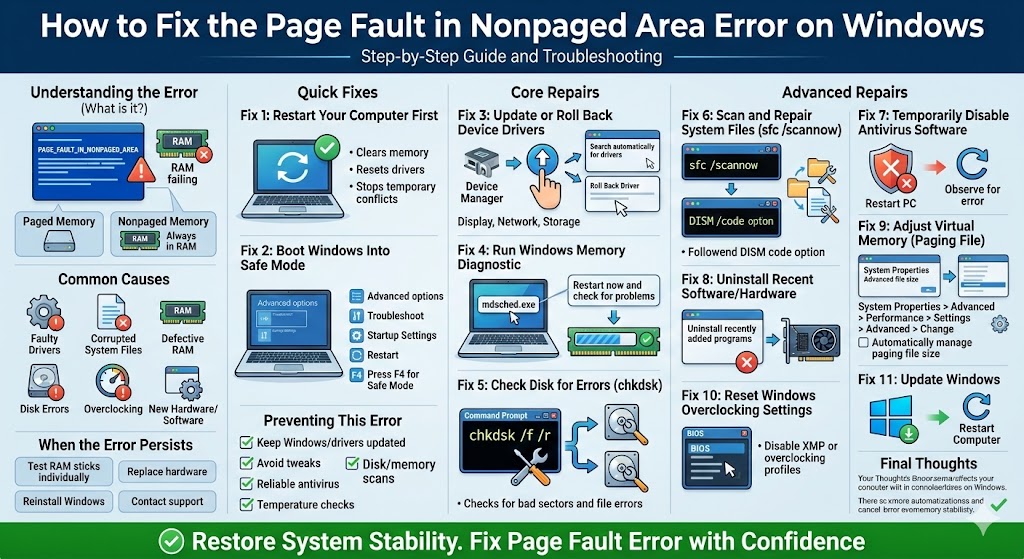
How to Fix the Page Fault in Nonpaged Area Error on Windows
The Page Fault in Nonpaged Area error is a well-known Blue Screen of Death (BSOD) issue in Windows. When it appears, your computer suddenly crashes, displays a blue screen, and restarts to prevent further system damage. This error can occur on Windows 10, Windows 11, and even earlier versions of Windows, often without warning.
Although it looks serious, the Page Fault in Nonpaged Area error is usually caused by memory-related problems, faulty drivers, corrupted system files, or incompatible software. With the right troubleshooting steps, you can fix the issue and restore system stability.
This complete guide explains what the error means, why it happens, and how to fix it step by step.
What Is the Page Fault In Nonpaged Area Error?
Windows divides system memory into two main sections:
-
Paged memory, which can be moved to disk when not in use
-
Nonpaged memory, which must stay in RAM at all times
The Page Fault in Nonpaged Area error occurs when Windows tries to access data that should always be available in RAM but cannot find it. When this happens, Windows cannot continue safely and triggers a system crash.
The error may appear with messages such as:
-
PAGE_FAULT_IN_NONPAGED_AREA
-
Stop code: PAGE_FAULT_IN_NONPAGED_AREA
Sometimes, the blue screen also mentions a specific file or driver name.
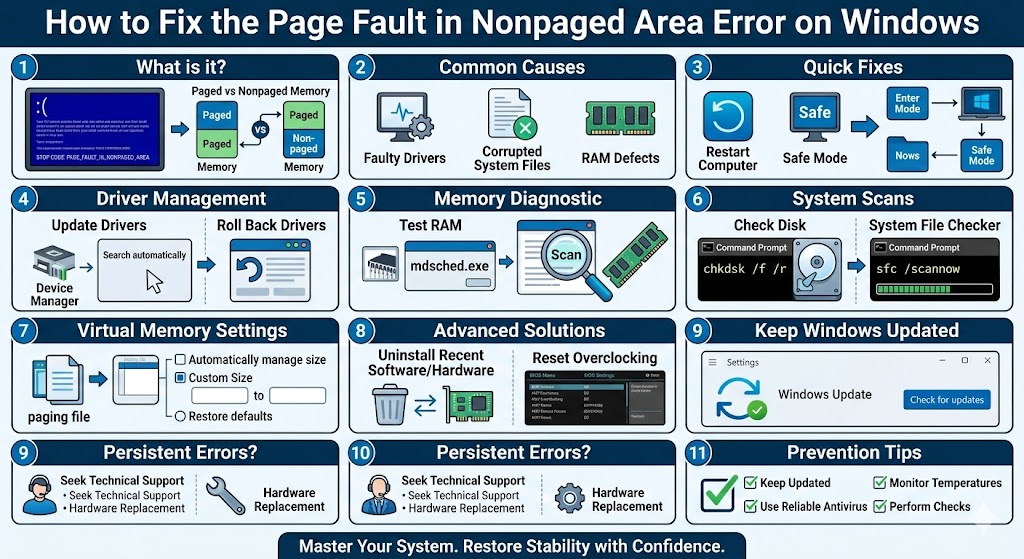
Common Causes of This Error
Understanding the root cause helps you choose the correct fix. The most common causes include:
-
Faulty or incompatible device drivers
-
Corrupted system files
-
Defective RAM
-
Antivirus or security software conflicts
-
Disk errors or bad sectors
-
Overclocking issues
-
Recently installed hardware or software
The error may appear after a Windows update, driver installation, or system change.
Restart Your Computer First
If the error happens only once, it may be caused by a temporary glitch.
Restarting your PC:
-
Clears memory
-
Resets drivers
-
Stops temporary system conflicts
If the error does not return after a restart, no further action may be needed.
Boot Windows Into Safe Mode
Safe Mode starts Windows with only essential drivers and services. If the error does not occur in Safe Mode, a third-party driver or program is likely responsible.
How to Enter Safe Mode
-
Restart your computer
-
Interrupt startup two or three times to open Automatic Repair
-
Select Advanced options
-
Go to Troubleshoot > Advanced options > Startup Settings
-
Click Restart
-
Press 4 or F4 for Safe Mode
Once in Safe Mode, proceed with troubleshooting.
Update or Roll Back Device Drivers
Faulty drivers are one of the most common causes of this error.
Update Drivers
-
Press Windows + X
-
Select Device Manager
-
Expand device categories
-
Right-click a device
-
Select Update driver
-
Choose Search automatically for drivers
Pay special attention to display drivers, network drivers, and storage controllers.
Roll Back Drivers
If the error started after a driver update:
-
Open Device Manager
-
Right-click the affected device
-
Select Properties
-
Go to the Driver tab
-
Click Roll Back Driver
Restart your computer afterward.
Run Windows Memory Diagnostic
Defective RAM can trigger Page Fault in Nonpaged Area errors.
How to Test RAM
-
Press Windows + R
-
Type
mdsched.exe -
Press Enter
-
Choose Restart now and check for problems
Windows will scan your memory during startup. If errors are found, faulty RAM may need to be replaced.
Check Disk for Errors
Hard drive or SSD issues can corrupt system data and cause blue screen errors.
Run Disk Check
-
Open Command Prompt as administrator
-
Type:
chkdsk /f /r -
Press Enter
-
Confirm and restart your computer
This scan checks for bad sectors and file system errors.
Scan and Repair System Files
Corrupted Windows system files can also cause this error.
Use System File Checker
-
Open Command Prompt as administrator
-
Type:
sfc /scannow -
Press Enter
Wait for the scan to complete and follow any on-screen instructions.
Use DISM if Needed
If SFC cannot fix errors:
Restart your PC after the process finishes.
Temporarily Disable Antivirus Software
Some third-party antivirus programs interfere with memory management and drivers.
What to Do
-
Temporarily disable your antivirus
-
Restart your computer
-
Observe whether the error returns
If the issue stops, update the antivirus or switch to a different security solution.
Uninstall Recently Installed Software or Hardware
If the error started after installing new software or hardware, it may be incompatible.
Steps
-
Uninstall recently added programs
-
Remove newly installed hardware
-
Restart the computer
Drivers or applications that access low-level system memory are especially likely to cause this error.
Turn Off Automatic Paging File Management
In some cases, paging file misconfiguration triggers this error.
Adjust Virtual Memory Settings
-
Open System Properties
-
Go to Advanced system settings
-
Click Settings under Performance
-
Open the Advanced tab
-
Click Change under Virtual Memory
-
Uncheck Automatically manage paging file size
-
Set a custom size or restore default settings
Restart your computer after applying changes.
Reset Windows Overclocking Settings
Overclocking CPU, GPU, or RAM can cause instability.
What to Do
-
Enter BIOS or UEFI settings
-
Reset values to default
-
Disable XMP or overclocking profiles
System stability often improves when running at default speeds.
Update Windows
Windows updates often include bug fixes and driver improvements.
How to Update Windows
-
Open Settings
-
Go to Windows Update
-
Click Check for updates
-
Install all available updates
Restart your computer after updating.
When the Error Persists
If the Page Fault in Nonpaged Area error continues after all troubleshooting steps:
-
Test RAM sticks individually
-
Replace faulty hardware
-
Reinstall Windows as a last resort
-
Seek professional technical support
Persistent errors often indicate hardware failure.
Preventing This Error in the Future
To reduce the chance of encountering this error again:
-
Keep Windows and drivers updated
-
Avoid unnecessary system tweaks
-
Use reliable antivirus software
-
Monitor system temperatures
-
Perform regular disk and memory checks
Preventive maintenance helps ensure long-term stability.
Final Thoughts
The Page Fault in Nonpaged Area error in Windows can be alarming, but it is usually fixable with the right approach. In most cases, the issue is caused by faulty drivers, corrupted system files, memory problems, or software conflicts.
Related articles
How to Fix the Page Fault in Nonpaged Area Error on Windows
Fixing the “Kernel Security Check Failure” Error on Windows 10